Ed and Lorraine Warren: America’s Most Famous Ghost Hunters and Their Darkest Secrets
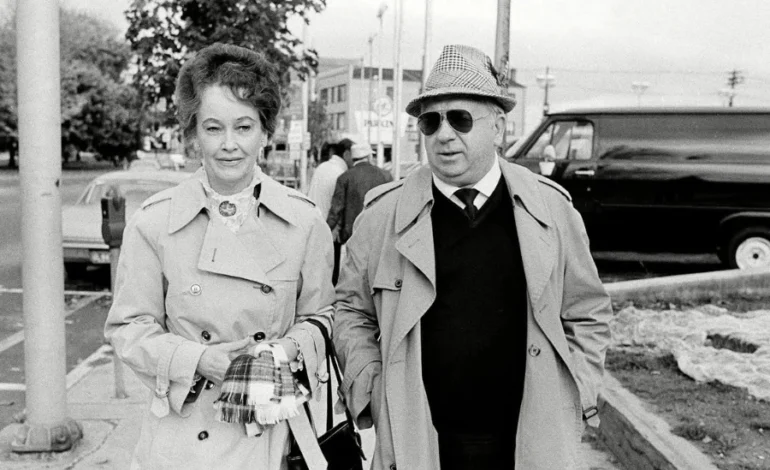
Ed and Lorraine Warren. The doll sits inside a glass case sealed with a Catholic binding prayer. It hasn’t moved since the Warrens locked it away — or so the story goes. Visitors to the Occult Museum in Monroe, Connecticut, were warned not to touch the case, not to taunt what’s inside, and not to walk away thinking none of it was real. One couple reportedly laughed at the exhibit on their way out. They didn’t make it home.
That story — unverified, atmospheric, impossible to disprove — is the perfect distillation of everything Ed and Lorraine Warren ever built. A world where skepticism itself becomes the danger. Where doubt is the enemy. Where faith, specifically Catholic faith, is the only weapon that works.
For more than five decades, the Warrens made America believe. Then, after Ed was gone and Lorraine was elderly and frail, the stories that had been suppressed for years finally started leaking out.
What emerged was considerably more frightening than anything they’d ever investigated.
Quick Bio
| Detail | Ed Warren | Lorraine Warren |
|---|---|---|
| Full Name | Edward Warren Miney | Lorraine Rita Moran |
| Born | September 7, 1926, Bridgeport, Connecticut | January 31, 1927, Bridgeport, Connecticut |
| Died | August 23, 2006, Monroe, Connecticut (age 79) | April 18, 2019, Monroe, Connecticut (age 92) |
| Married | 1945 | 1945 |
| Child | Judy Warren (b. January 11, 1946) | Judy Warren (b. January 11, 1946) |
| Grandchildren | Four | Four |
| Professed roles | Self-taught demonologist, author, lecturer, artist | Clairvoyant, light trance medium, author |
| Founded | New England Society for Psychic Research (NESPR), 1952 | New England Society for Psychic Research (NESPR), 1952 |
| Cases claimed | Over 10,000 paranormal investigations | Over 10,000 paranormal investigations |
| Religion | Roman Catholic | Roman Catholic |
| Buried | Stepney Cemetery, Monroe, Connecticut | Stepney Cemetery, Monroe, Connecticut |
| Film franchise inspired | The Conjuring Universe (8+ films) | The Conjuring Universe (8+ films) |
Two Kids from Bridgeport
They came from the same city, a year apart. Bridgeport, Connecticut, in the 1920s and 1930s was a working-class industrial town — not glamorous, not mystical, the kind of place where people worked hard and didn’t ask too many questions about the things that went bump in the night.
Ed Warren was born on September 7, 1926. His childhood was not a normal one, at least by his account. According to his authorized biography, The Demonologist, published in 1980, Ed reported his first supernatural experience at five years old — claiming he saw the ghost of a recently deceased landlady materialize in his family home as a small dot of light. Whether that’s true or not, it’s the story he told for the rest of his life, and it shaped everything that followed.
Lorraine Rita Moran was born on January 31, 1927, less than five months after Ed. She grew up in Bridgeport too, attending Lauralton Hall, a prestigious Catholic girls’ high school in Milford, Connecticut. By her own account, she’d been aware of unusual perceptions since she was seven or eight years old — seeing what she described as auras around people, abilities she was too frightened to share with her parents.
Two children from the same industrial town, each carrying something they couldn’t explain. Neither knew about the other yet.
The collision came at a movie theater.
The Theater, the Usher, and the Vision
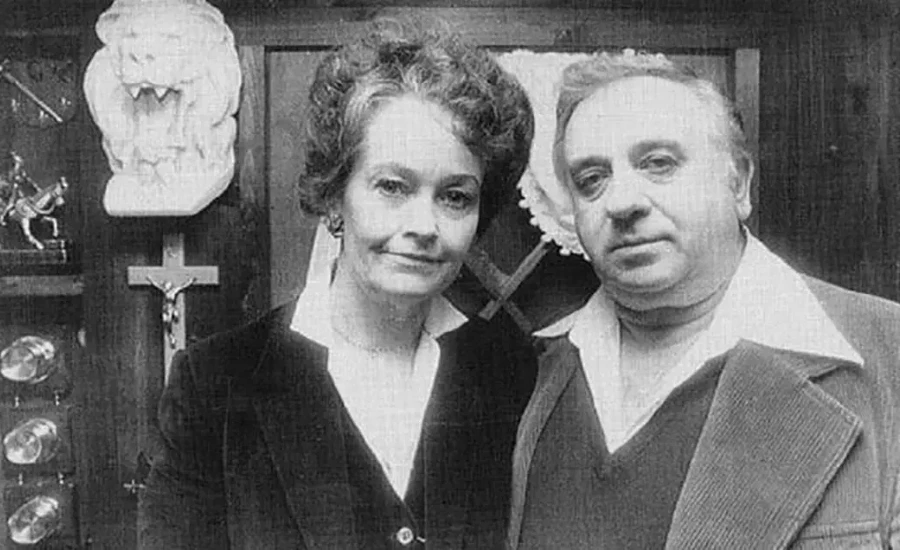
When Ed was sixteen, he worked as an usher at the Colonial Theater in Bridgeport. Lorraine and her mother were regular customers. Ed noticed her. He introduced himself. They started talking.
On their first date, Lorraine later claimed, she had a vision of Ed as a much older man. She was certain — in the way that only a teenager can be completely certain about something — that she’d spend the rest of her life with him. She was right, though the life ahead of them was nothing either of them could have predicted from that movie-theater conversation.
Their courtship was brief. Ed enlisted in the Navy on his seventeenth birthday, was deployed for four months before his ship was sunk in the North Atlantic, and returned home on thirty days of “Survivor’s Leave.” During that leave, they married. The year was 1945. Ed was eighteen. Lorraine was seventeen.
The war ended. Ed came home for good. In 1946, Lorraine gave birth to their only child, a daughter named Judy. Ed enrolled at the Perry Art School, a Yale subsidiary, where his paintings — mostly Connecticut haunted houses rendered in oils — earned him a modest reputation. After two years, he left school. He and Lorraine set up stands across tourist areas of Massachusetts, Vermont, Rhode Island, and coastal Connecticut, selling Ed’s paintings of eerie Victorian homes.
That’s how it started. Not with spirits or demons. With oil paintings and tourist traffic.
The Turning Point: From Canvas to Casework
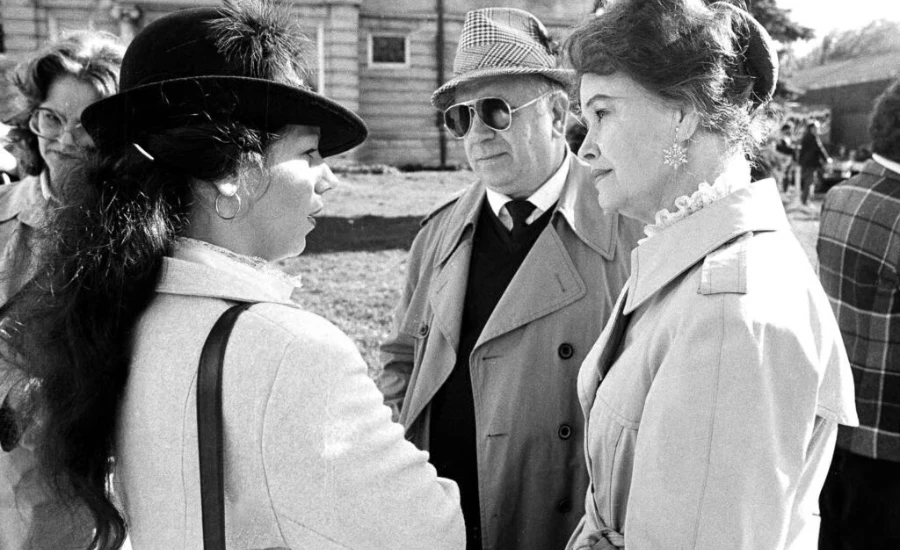
The paintings were a side door into something Ed had always been looking for. When he heard reports that a house was haunted, he’d drive out, stand on the street, and sketch the structure from the curb. Then he’d approach the homeowners with the completed sketch — a friendly gesture, a way to get through the front door. The tactic worked more often than it had any right to.
Lorraine was, by her own later admission, a skeptic at the time. Whatever she could see or sense, she hadn’t yet framed it as a gift. She went along with Ed’s investigations because he believed, and because their connection to the subject was growing into something that felt bigger than a hobby.
In 1952, they made it official. They founded the New England Society for Psychic Research — the NESPR — which became the oldest ghost-hunting organization in New England. It wasn’t until 1968, when an art show of Ed’s paintings drew unexpected crowds of people eager to share their own supernatural experiences, that the Warrens’ notoriety shifted from local curiosity to something approaching a career.
From that point forward, the bookings multiplied. A talent agency began scheduling college lectures across the country. Ed worked the room like a revival preacher — the demonologist in a suit, armed with Catholic conviction and a self-developed taxonomy of demonic possession he’d outlined in five stages without a single theological credential to his name.
Lorraine stood beside him, smaller in frame, quieter in delivery, and — to those who believed in her — more dangerous. She claimed direct sensory access to what most people can’t perceive. She said she could feel what was in a room. She said she could walk into a house and know whether something was there.
Skeptics had a different word for it. The New England Skeptical Society investigated the Warrens in 1997, took the $13 tour, watched the videos, and examined the best evidence on offer. Their verdict: “It’s all blarney.”
The Warrens kept going anyway.
The Cases That Built an Empire
Over five decades, Ed and Lorraine Warren claimed to have investigated more than 10,000 paranormal cases, conducted over 7,000 interviews, and personally witnessed some 700 exorcisms. Those numbers strain credibility — for context, that’s roughly one new case every two days for fifty years — but the Warrens never shied from scale.
A handful of cases defined them publicly, and those same cases would later define Hollywood’s most profitable horror franchise.
The Annabelle Doll (1970)
A student nurse named Donna received a Raggedy Ann doll as a gift. She and her roommate began noticing the doll moved between rooms on its own, and found handwritten notes in the apartment reading “Help Us.” A medium they consulted told them the doll was inhabited by the spirit of a young girl named Annabelle Higgins. The situation escalated. Donna’s roommate’s boyfriend claimed the doll attacked him in his sleep.
The Warrens were called in. Their conclusion differed sharply from the medium’s: this wasn’t a benevolent spirit, they said. It was a demonic presence using the appearance of a child to manipulate humans into offering it a host body. They removed the doll and locked it in a glass case at their Occult Museum, sealed with a Catholic binding prayer.
The real Annabelle remains a Raggedy Ann doll — soft, red-haired, innocuous-looking. The horror movie version was redesigned into a porcelain-faced monstrosity. Lorraine’s own daughter Judy, who grew up with the real doll nearby, said the original is far more unsettling than the movie prop: “It’s much easier to look at the movie Annabelle. The real one is so innocent-looking and yet so evil.”
The Perron Family (1971)
Roger and Carolyn Perron moved their five daughters into a farmhouse in Harrisville, Rhode Island, in January 1971. Almost immediately, the family reported unusual experiences — sounds, apparitions, and what they described as a hostile presence. The Warrens became involved, identifying the entity as the spirit of a witch named Bathsheba Sherman, who they claimed had cursed anyone who lived on the land.
Lorraine Warren once held a séance at the farmhouse that reportedly disturbed the Perron family so profoundly they asked the Warrens to leave. That detail doesn’t appear in The Conjuring, the 2013 film that transformed this case into a $319.5 million box-office phenomenon. The film starring Patrick Wilson and Vera Farmiga as the Warrens introduced the couple to a global audience that hadn’t been born when these investigations took place.
The Amityville Horror (1975–1976)
This is the case that made the Warrens famous beyond New England. In November 1974, Ronald DeFeo Jr. murdered his entire family while they slept in their house in Amityville, New York. The following year, George and Kathleen Lutz moved in with their children and fled within 28 days, claiming demonic manifestations so severe the house was uninhabitable.
The Warrens investigated and corroborated the Lutz family’s account. Lorraine reported feeling immense pressure inside the structure and difficulty breathing. Ed described it as one of the most demonically active locations he’d ever encountered.
The 1977 book The Amityville Horror became a bestseller. The 1979 film began a franchise. The Warrens were central to propagating the story.
They were also, critics later argued, central to keeping a fiction alive. In 1979, the Lutz family’s own lawyer William Weber stated publicly that he, author Jay Anson, and the Lutzes had constructed the haunting story together — over wine. Skeptical investigators Benjamin Radford and Joe Nickell concluded the story had been invented outright. The Amityville Authors Stephen and Roxanne Kaplan characterized the whole case as a hoax.
The Warrens disagreed and never changed their account.
The Arne Cheyenne Johnson Case (1981)
This one ended in a courtroom. A boy in Connecticut apparently needed an exorcism; the Warrens arranged for a priest. According to the Warrens’ account, the demon fled the child’s body and entered Arne Cheyenne Johnson, the fiancé of the boy’s sister. Shortly after, Johnson fatally stabbed his landlord, Alan Bono. His defense team attempted to argue demonic possession — the first time such a claim was used in a U.S. murder trial. The court rejected it. Johnson was convicted of first-degree manslaughter.
The Conjuring: The Devil Made Me Do It (2021) dramatized this case. The film did not include the part where the defense failed entirely.
Personal Life: The Partnership Behind the Brand
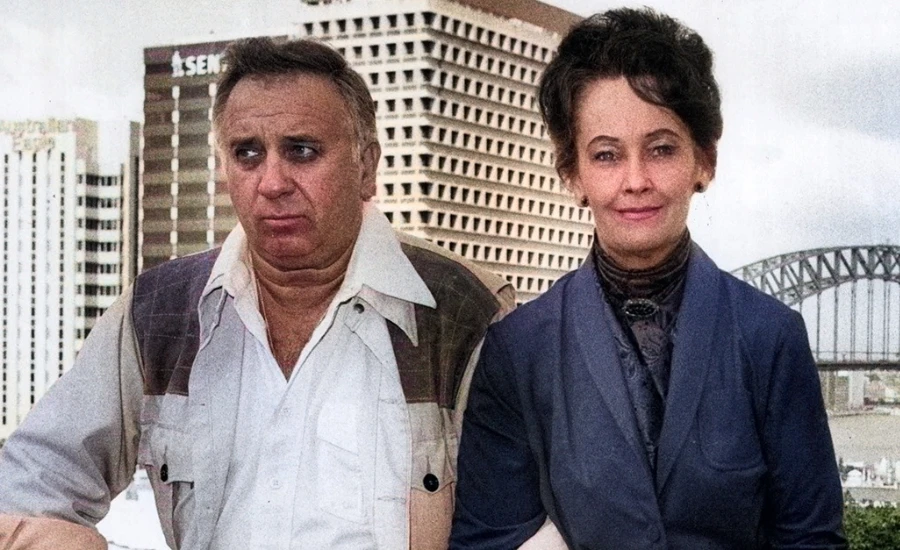
Ed and Lorraine Warren were members of the Roman Catholic Church, and they framed their entire career within that faith. Demons were real because God was real. They were investigators, not occultists. They weren’t trying to contact spirits for sport — they were holding the line against forces they believed were genuinely evil.
That framework gave their work a moral clarity that resonated with mainstream audiences in a way pure ghost-hunting never could. They weren’t just curious; they were faithful soldiers.
Their daughter Judy was largely shielded from the family business. The supernatural frightened her as a child, and her parents chose to protect her from the more disturbing cases rather than fold her into the work. She has said she possesses some psychic ability but has never developed it — partly by choice, partly because what she heard growing up scared her enough that she preferred not to know more.
The Warrens lived in Monroe, Connecticut, for most of their adult lives, keeping the Occult Museum — a basement collection of allegedly haunted artifacts and demonic relics gathered over decades — in their home. They trained other demonologists, including their nephew John Zaffis. They wrote books, gave lectures, and became something approaching celebrities in the paranormal community.
Ed died on August 23, 2006, in Monroe. He was 79.
Lorraine outlived him by nearly thirteen years, continuing to consult on the Conjuring films and make public appearances until her health failed. She died quietly in her sleep on April 18, 2019, at the age of 92 — in the same Connecticut town where she and Ed had built everything.
They’re buried together at Stepney Cemetery in Monroe.
Controversies: The Stories That Didn’t Make the Movies
The Conjuring franchise has grossed over a billion dollars. Behind that figure is an agreement that made sure certain things would never appear on screen.
When Lorraine Warren negotiated her consulting contract with New Line Cinema, she had specific language written in: neither she nor Ed could be depicted engaging in extramarital affairs, nor “crimes, including sex with minors.” Talent attorneys who reviewed the contract said the specificity of that language was unusual. They’d never seen anything quite like it in a studio deal.
That language was there for a reason.
The Judith Penney Allegations
In 2014, a woman named Judith Penney gave a sworn declaration in the context of a lawsuit over the Conjuring franchise’s profits. She alleged that she had met Ed Warren in the early 1960s, when she was fifteen years old and he was working as a city bus driver in Monroe, Connecticut. She rode his bus. They began what she described as an “amorous relationship.” By 1963, she said, she had moved into the Warrens’ home. She claimed the relationship continued for forty years, with Lorraine’s full knowledge.
Penney’s account surfaced publicly in a 2017 Hollywood Reporter exposé — one of the most detailed examinations of the gap between the Warrens’ public image and what those close to them claimed was their private reality.
The allegations do not exist in isolation. A 1963 arrest record shows Penney was brought before authorities because it was illegal at the time for an unmarried woman to cohabitate with a married man. She refused to admit to the affair in court and was ordered to attend a delinquent youth office for a month. Ed allegedly continued driving her to those mandatory sessions while they covered their tracks by telling people she was a poor local girl they’d taken in as a charity case, or sometimes his niece.
According to Penney, in 1978 she became pregnant with Ed’s child. Lorraine, she alleged, pressured her to have an abortion and to falsely claim she’d been raped by an intruder. Penney refused to lie about the rape. She had the abortion. Ed and Lorraine went out to lecture that night and left her alone in the house to recover.
Penney also alleged that Ed was physically abusive to Lorraine — that she witnessed him backhand his wife so hard that Lorraine lost consciousness. She described their household as a place of fear as much as faith.
The Response
The Warrens’ daughter Judy and son-in-law said they never witnessed any of the alleged conduct. Lorraine’s attorneys described her client as elderly, declining, and unable to respond, characterizing the allegations as driven by a lawsuit vendetta. Ed had been dead for over a decade by the time the allegations became widely known.
These accusations were made in civil court documents and recorded statements. They were not tested in criminal court. They have not been proven or disproven in a legal setting. Ed Warren is not alive to respond. The truth of what happened inside that Monroe, Connecticut, household remains contested.
What is not contested: the contract language was unusual. The Conjuring films continued to portray the Warrens as a devoted, faithful couple. And Lorraine’s estate benefited from every one of them.
The Fraud Questions
The Penney allegations aren’t the only shadow over the Warrens’ legacy. Horror author Ray Garton, who was hired to write a book about one of the Warrens’ cases involving the Snedeker family in Connecticut, later said that the family members couldn’t keep their stories consistent and that Ed himself told him directly: “Make it scary.” Garton understood this to mean he should fill in the gaps with invention. He did, and later regretted it.
Skeptical investigator Benjamin Radford has been blunt: the Warrens’ most famous cases, including Amityville and the Snedeker haunting, show clear evidence of fabrication. The Warrens, in his view, weren’t investigating hauntings — they were constructing them.
The Warrens’ own position never wavered: the forces are real, the cases are real, and disbelief is exactly what the enemy wants.
Conclusion
Ed and Lorraine Warren left behind something that no amount of skeptical debunking has managed to undo: a cultural apparatus that keeps expanding.
The Conjuring Universe now spans eight films and counting, including The Conjuring: Last Rites released in 2025. Patrick Wilson and Vera Farmiga became the faces of one of horror’s most successful franchises by playing idealized versions of two people who may have been very different in private. The films made the Warrens immortal in a way that no number of college lectures or book signings ever could have.
The real Annabelle doll sits in its glass case in a Connecticut museum, still drawing visitors. The Occult Museum collection — artifacts gathered across decades of investigations — continues to attract interest from paranormal enthusiasts who make the pilgrimage to Monroe.
Their nephew John Zaffis carries the investigative work forward. The NESPR still exists. The Warrens’ cases are taught in academic courses on American religious and cultural history, usually as examples of how paranormal belief functions in modern society.
Whether they were sincere believers, calculated frauds, or something far more complicated than either — two people who genuinely believed in what they did and also built a business out of it, which is its own kind of human story — remains genuinely unresolved.
What’s clear is the scale of what they made. From a Connecticut movie theater in the 1940s to a billion-dollar horror franchise. From oil paintings of haunted houses to a locked glass case that the whole world knows by name.
Ed died in 2006. Lorraine died in 2019. They’re buried together in Monroe.
The doll is still there.
You may also like Emily Threlkeld
FAQ’s
1. Who were Ed and Lorraine Warren?
Ed and Lorraine Warren were American paranormal investigators and authors from Bridgeport, Connecticut. Ed (1926–2006) was a self-taught demonologist; Lorraine (1927–2019) claimed to be a clairvoyant and light trance medium. They founded the New England Society for Psychic Research in 1952 and claimed to have investigated more than 10,000 paranormal cases across their career. Their case files inspired The Conjuring film franchise.
2. How did Ed and Lorraine Warren meet?
Ed was working as a movie theater usher in Bridgeport when he met Lorraine, who attended regularly with her mother. They began dating in their mid-teens. Lorraine later claimed that on their first date she had a psychic vision of Ed as an elderly man and knew immediately he would be her husband.
3. When did Ed and Lorraine Warren get married?
They married in 1945 while Ed was on survivor’s leave from the Navy after his ship was sunk in the North Atlantic. Ed was eighteen; Lorraine was seventeen.
4. How many children did the Warrens have?
One daughter, Judy Warren (born January 11, 1946), who married Tony Spera and had four children. Judy was largely shielded from the family’s paranormal work as she grew up, as it frightened her.
5. What is the New England Society for Psychic Research?
The NESPR is the organization Ed and Lorraine Warren founded in 1952 to formally organize their paranormal investigations. It is the oldest ghost-hunting group in New England and still exists today under family management.
6. What is the Annabelle doll?
The Annabelle doll is a Raggedy Ann doll that two Connecticut roommates claimed behaved abnormally in 1970. The Warrens declared it was not haunted by a child’s spirit but manipulated by a demonic presence. They took the doll and sealed it in a glass case at their Occult Museum. The real doll is the basis for the Annabelle film trilogy, though the movie version was redesigned to look far more sinister.
7. What was the Amityville Horror case?
After Ronald DeFeo Jr. murdered his family in their Amityville, New York, home in 1974, the Lutz family moved in and reported intense paranormal phenomena before fleeing. The Warrens investigated and supported the Lutz account. Critics including the Lutzes’ own former attorney later claimed the haunting was invented. The case became a bestselling 1977 book and a 1979 film. Most skeptical investigators consider it a hoax.
8. What happened to Ed Warren?
Ed Warren died on August 23, 2006, in Monroe, Connecticut, at age 79. The cause of his death was not widely reported. He is buried at Stepney Cemetery in Monroe.
9. What happened to Lorraine Warren?
Lorraine Warren died on April 18, 2019, in Monroe, Connecticut, at age 92. She died peacefully in her sleep at home. She had continued consulting on The Conjuring films in her later years. She is buried beside Ed at Stepney Cemetery.
10. Who plays Ed and Lorraine Warren in the movies?
Patrick Wilson portrays Ed Warren and Vera Farmiga portrays Lorraine Warren in The Conjuring series. Both actors have appeared in multiple installments of the franchise.
11. What were the allegations against Ed Warren?
In a sworn declaration given in November 2014 and first widely reported by The Hollywood Reporter in 2017, a woman named Judith Penney alleged that Ed Warren initiated a sexual relationship with her when she was fifteen years old and he was in his mid-thirties. She claimed Lorraine Warren was aware of the relationship and that it continued for approximately forty years. She also alleged Ed was physically abusive to Lorraine and that Ed was involved in staging at least some paranormal “evidence.” These allegations were made in civil litigation, were denied by the Warren family, and were never adjudicated in a criminal proceeding. Ed Warren had died in 2006, over a decade before the allegations became widely public.
12. Were the Warrens real investigators or frauds?
This remains genuinely contested. Multiple skeptical investigators — including Perry DeAngelis, Steve Novella, Joe Nickell, and Benjamin Radford — concluded that the Warrens’ most famous cases were fabricated or drastically exaggerated. At least one co-author of a Warren case book later acknowledged being asked to make stories “scary” regardless of the facts. The Warrens themselves never conceded any fraud. Their daughter Judy and other family members maintain the sincerity of the investigations.
13. What is the Occult Museum?
The Warrens’ Occult Museum is a collection of allegedly haunted artifacts and demonic objects gathered during investigations, housed in their Monroe, Connecticut, home. It includes the sealed glass case containing the Annabelle doll. The museum attracted visitors and became a destination for paranormal enthusiasts. Its current operational status following Lorraine’s death in 2019 has varied.
14. How did the Warrens influence The Conjuring Universe?
Lorraine Warren served as a consultant on the Conjuring films, including her insistence on a contract clause preventing the portrayal of the Warrens engaging in extramarital affairs or crimes involving minors. The franchise, launched with The Conjuring in 2013, has expanded to include eight or more films and has grossed over a billion dollars.
15. Where are Ed and Lorraine Warren buried?
Both are buried at Stepney Cemetery in Monroe, Connecticut.